![Logo_quer_farbig.png]](https://docs.sentinum.de/hs-fs/hubfs/Logo_quer_farbig.png?height=40&name=Logo_quer_farbig.png)
1. Version History
| Version | Date | Revision |
|---|---|---|
| 1.0.0 | June 2, 2025 | Created |
| 1.0.1 | March 25, 2026 |
|
2. Overview
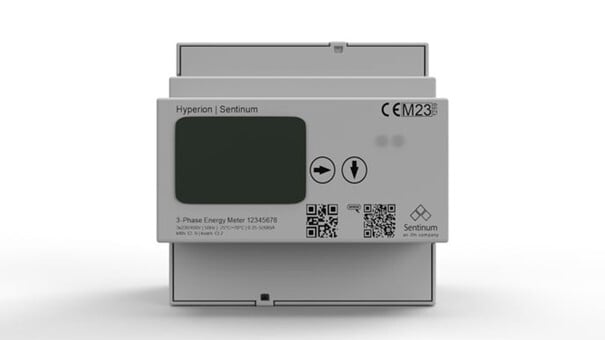
The Hyperion energy meter is a device from Sentinum that transmits energy measurement data via the MIOTY communication protocol. This document describes the payload structure, available profiles, and field definitions for firmware version 1.3 and higher.
Device Information:
-
EUI Type:
FCA84A0000000006 - Manufacturer: Sentinum
- Protocol: MIOTY
- Supported version: 1.3+
3. Payload Structure
Header (same for all profiles)
Every Hyperion payload begins with a common header structure:
| Field | Size | Type | Description |
|---|---|---|---|
FW_BASE_ID |
4 bits | Uint | Firmware base identifier |
FW_MAJOR_VER |
4 bits | Uint | Major version of the firmware |
FW_MINOR_VER |
4 bits | Uint | Firmware minor version |
DEV_SUB_TYPE |
4 bits | Uint | Device subtype identifier |
MSG_COUNTER |
8 bits | Uint | Counter for uplink messages |
STATUS |
8 bits | Uint | Device status (0 = Normal operation) |
SERIAL_NUM |
32-bit | Uint | Visible serial number of the device |
APP_VERSION |
32-bit | Uint | Visible application version |
MID_VERSION |
32-bit | Uint | Visible middleware version |
PROFIL |
32-bit | Uint | Payload profile selector (0–4) |
Payload Requirements:
-
Payload data is only transmitted if
fw_minor_ver >= 3andstatus == 0. - The profile selection is controlled via the profile field.
4. Payload Profiles
The payload profiles are described below.
4.1. Profile 0: Complete Energy Data (Big Endian)
Purpose: Comprehensive electrical measurements, including power, current, voltage, energy meters, and power quality parameters.
Parameters:
Power measurements (W):
-
p_l1_a,p_l2_a,p_l3_a: Active power per phase -
p_l123_a: Total active power (sum of all phases)
Current measurements (mA):
-
i_l1,i_l2,i_l3: Current per phase -
i_l123: Total current
Voltage measurements (V, scaled by /10):
-
u_l1,u_l2,u_l3: Phase voltages -
u_l12,u_l23,u_l31: Line-to-line voltages
Energy meter (Wh):
-
e_ta_a_i: Total active energy import -
e_ta_a_e: Total active energy export -
e_ta_r_i: Total reactive energy import -
e_ta_r_e: Total reactive energy export
Power quality:
-
pf_l1,pf_l2,pf_l3: Power factor per phase (scaled by /100) -
f: Frequency in Hz (scaled by /10)
System status:
-
pwr_fail: Power failure counter
4.2. Profile 1: Focus on voltage and current (Big Endian)
Purpose: Detailed voltage and current measurements with power quality metrics.
Fields:
Voltage measurements (V, scaled by /10):
-
u_l1,u_l2,u_l3: Phase voltages -
u_l12,u_l23,u_l31: Line voltages
Current measurements (mA):
-
i_l1,i_l2,i_l3: Current per phase -
i_l123: Total current
Line quality:
-
pf_l1,pf_l2,pf_l3: Power factor per phase (scaled by /100) -
f: Frequency in Hz (scaled by /10)
4.3. Profile 2: Power and Current Analysis (Big Endian)
Purpose: Focuses on power measurements and current analysis with power quality.
Fields:
Power measurements (W):
-
p_l1_a,p_l2_a,p_l3_a: Active power per phase -
p_l123_a: Total active power
Current measurements (mA):
-
i_l1,i_l2,i_l3: Current per phase -
i_l123: Total current
Line quality:
-
pf_l1,pf_l2,pf_l3: Power factor per phase (scaled by /100) -
f: Frequency in Hz (scaled by /10)
4.4. Profile 3: Energy Meter Only (Big Endian)
Purpose: Energy accumulation data for billing and monitoring applications.
Fields:
Energy meter (Wh):
-
e_ta_a_i: Total active energy import -
e_ta_a_e: Total active energy export -
e_ta_r_i: Total imported reactive power -
e_ta_r_e: Total reactive energy export
4.5. Profile 4: Extended Historical Data (Little Endian)
Purpose: Comprehensive historical data with time-based energy records and configuration parameters.
Fields:
Time and Index
- Index: Data set index
- epoch: Current timestamp
- epoch_old: Previous timestamp
Time-based energy meters
Tariff 1 (T1)
-
e_t1_a_i: Active energy import -
e_t1_a_e: Active energy export -
e_t1_r_i: Reactive power import -
e_t1_r_e: Reactive power feed-in
Tariff 2 (T2)
-
e_t2_a_i: Active energy import -
e_t2_a_e: Active energy export -
e_t2_r_i: Reactive energy import -
e_t2_r_e: Reactive energy export
Current measurements (mA)
-
i_l1,i_l2,i_l3: Current per phase -
i_l4: Additional current measurement -
i_l123: Total current
Power measurements (W)
-
p_l1_a,p_l2_a,p_l3_a: Active power per phase -
p_l123_a: Total active power -
p_l123_a_avg: Average total active power
Voltage measurements (V, scaled by ÷10)
-
u_l1,u_l2,u_l3: Phase voltages
Line quality
-
f: Frequency in Hz (scaled by ÷10) -
pf_l1,pf_l2,pf_l3: Power factor per phase (scaled by ÷10)
Transformer configuration
-
ct_act_prim: Actual primary ratio of the current transformer -
ct_old_prim: Current transformer old primary ratio -
ct_act_sec: Current transformer actual secondary ratio -
ct_old_sec: Current transformer old secondary ratio -
vt_act_prim: Voltage transformer actual primary ratio -
vt_old_prim: Voltage transformer old primary ratio -
vt_act_sec: Voltage transformer actual secondary ratio vt_old_sec: Voltage transformer – old secondary ratio
5. Data Decoding
Endianness
- Profiles 0–3: Big-endian encoding
- Profile 4: Little-endian encoding
Data types and scaling
| Component | Size | Type | Scale | Unit | Description |
|---|---|---|---|---|---|
VOLTAGE_* |
32-bit | int | ÷10 | V | Voltage measurements |
CURRENT_* |
32-bit | int | 1:1 | mA | Current measurements |
POWER_* |
32-bit | int | 1:1 | W | Power measurements |
ENERGY_* |
64-bit | uint | 1:1 | Wh | Energy accumulation |
| POWER FACTOR | 8-bit | int | ÷100 (÷10 for LE) | - | Power factor (-1.0 to 1.0) |
| FREQUENCY | 16-bit | int | ÷10 | Hz | Mains frequency |
| EPOCH | 64-bit | uint | 1:1 | seconds | Unix timestamp |
CT_* / VT_* |
16-bit | uint | 1:1 | - | Transformer ratios |
Field Naming Convention
- Voltage:
u_lX(X = Phasennummer oder Leitungsbezeichnung) - Current:
i_lX(X = Phasennummer oder Gesamtwert) - Power:
p_lX_a(Wirkleistung, X = Phase oder Gesamtwert) -
Energy:
e_tX_Y_Z- t = Tarif (
ta= Gesamt,t1/t2= Tarif 1/2) - Y = Energieart (
a= Wirkenergie,r= Blindenergie) - Z = Richtung (
i= Import,e= Export)
- t = Tarif (
- Power Factor:
pf_lX(X = Anzahl der Phasen) - Frequency:
f -
Transformer Ratios:
ct_*= Stromwandler,vt_*= Spannungswandler -
Format:
{ct|vt}_{act|old}_{prim|sec}für aktuelle/historische Primär- und Sekundärwerte
6. Application Examples
- Profile 0: Für umfangreiches Monitoring mit allen verfügbaren Parametern.
- Profile 1: Für Power-Quality-Analysen und Lastüberwachung.
- Profile 2: Für Leistungsanalysen und Lastüberwachung.
- Profile 3: Für Abrechnungsanwendungen, bei denen ausschließlich Gesamtenergiewerte benötigt werden.
- Profile 4: Für historische Datenerfassung und erweiterte Analysen.
7. Data Interpretation
// Example: Converting voltage reading
const voltage_raw = 2350; // Raw value from u_l1
const voltage_actual = voltage_raw / 10; // = 235.0 V

// Example: Converting power factor
const pf_raw = -85; // Raw value from pf_l1 (big-endian profiles)
const pf_actual = pf_raw / 100; // = -0.85 (capacitive load)

// Example: Energy consumption calculation
const energy_import = e_ta_a_i; // in Wh
const energy_export = e_ta_a_e; // in Wh
const net_consumption = energy_import - energy_export; // Net energy

// Example: Transformer ratio interpretation
const ct_primary = ct_act_prim; // Current transformer primary ratio
const ct_secondary = ct_act_sec; // Current transformer secondary ratio
const ct_ratio = ct_primary / ct_secondary; // Actual CT ratio
8. Version Compatibility
This design supports Hyperion firmware version 1.3 and higher.
The payload structure depends on the following conditions:
-
fw_minor_ver >= 3: Required for the transmission of payload data. -
status == 0: Indicates normal operating status. Payload data is only available when this condition is met.
For firmware versions prior to 1.3, only header information is available.
9. Technical Notes
- No hidden fields: All data fields are visible and accessible in the decoded payload.
- Visible components: Serial numbers, version information, and CT/VT ratios are transmitted transparently and can be decoded directly.
- Conditional logic: All payload fields depend on firmware version, device status, and the selected profile.
- Data validation: Correct handling of endianness is required when implementing payload decoders.
- Profile optimization: Different profiles optimize payload size for specific use cases and application scenarios.
- Time-based data: Profile 4 contains historical data including epoch timestamps for advanced time-series analysis.
- Transformer ratios: CT and VT ratios are transmitted as 16-bit values representing the active transformer configuration.
- Optimized design: Optimized component definitions reduce unnecessary complexity while maintaining full functionality.