![Logo_quer_farbig.png]](https://docs.sentinum.de/hs-fs/hubfs/Logo_quer_farbig.png?height=40&name=Logo_quer_farbig.png)
1. Product Overview
The solar-powered, wireless IoT sensor NYX is an innovative solution for monitoring indoor environmental parameters. Solar-powered and only 8 mm thin, it offers a maintenance-free and attractive design for indoor spaces.
The sensor detects temperature, relative humidity and ambient light. The sensor is available with LoRaWAN® and mioty® with different sensor configurations.
Please observe the warnings and instructions in the operating instructions to ensure the safety of you, your surroundings and the sensor.
2. Assembly and Installation
Install the wall mount on an interior wall at a height of 1.50 m to 1.80 m in a location with at least 400 lux per day. Ensure a minimum distance of 20 cm from people and operation below 2000 m above sea level.
3. Commissioning and NFC Parameterization
The sensor is shipped already powered on. It is activated via an NFC app. A smartphone is required for this. The app can be downloaded from the respective app stores . Simply search for "Sentinum LinQs" and download the LinQs app.
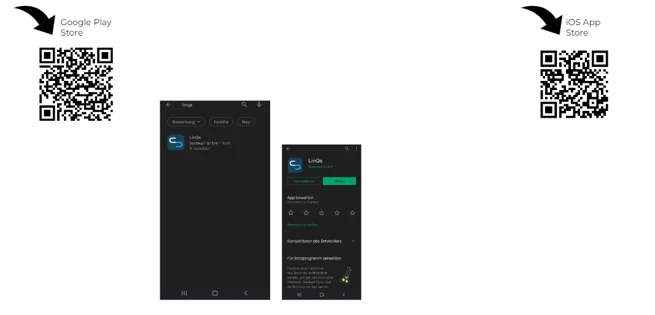
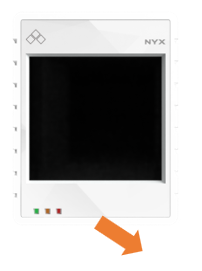
First, locate the tag on the sensor, and then locate the NFC reader on your device. The exact location of the NFC tag on the sensor is shown in the following illustration.
4. Payload Decoder – NYX Series
function decodeUplink(input) {
    var decoded = {};
    var bytes = input.bytes;

    if (input.fPort == 1) {

        decoded.base_id = bytes[0] >> 4;
        decoded.major_version = bytes[0] & 0x0F;
        decoded.minor_version = bytes[1] >> 4;
        decoded.product_version = bytes[1] & 0x0F;
        decoded.up_cnt = bytes[2];
        decoded.battery_voltage = ((bytes[3] << 8) | bytes[4]) / 1000.0;
        decoded.internal_temperature =
            ((bytes[5] << 8) | bytes[6]) / 10 - 100;
    }

    return {
        data: decoded,
        warnings: [],
        errors: []
    };
}